Wireless and Network Engineering
Master's
The Master of Science in Wireless and Network Engineering bridges electrical engineering and computer engineering to prepare you for specialized careers in the rapidly evolving communication networked systems workplace.
Program overview
Help unite a hyperconnected world
Offered by the Institute for the Wireless Internet of Things and the Department of Electrical and Computer Engineering, the MS in Wireless and Network Engineering program equips you to become a qualified researcher and specialized professional in our hyperconnected world.
Merging studies from traditionally separate technical fields, this program integrates concepts from electrical engineering (communications, signal processing, and control) and computer engineering (computer networking, security, and policy).
You’ll gain a multifaceted skill set through a combination of coursework, master’s thesis research, and/or industry experience. Extensive co-op and research opportunities are available through major companies in the wireless, defense, computing, and manufacturing fields.
Offered by the Institute for the Wireless Internet of Things and the Department of Electrical and Computer Engineering, the MS in Wireless and Network Engineering program equips you to become a qualified researcher and specialized professional in our hyperconnected world.
Merging studies from traditionally separate technical fields, this program integrates concepts from electrical engineering (communications, signal processing, and control) and computer engineering (computer networking, security, and policy).
You’ll gain a multifaceted skill set through a combination of coursework, master’s thesis research, and/or industry experience. Extensive co-op and research opportunities are available through major companies in the wireless, defense, computing, and manufacturing fields.
- Through an innovative curriculum combining concepts from electrical and computer engineering, students are prepared to cover the protocol stack in its entirety, from communications and signal processing to networking and applications.
- Students will find extensive experiential opportunities offered through industry and government collaborations facilitated by the Institute for the Wireless Internet of Things at Northeastern.
- Advanced on-campus facilities and their unique provisions, including being among one of the nation’s only FCC-designated Spectrum Innovation Zones, afford access to cutting-edge technologies in the field of communication networks.
Cisco projects that by 2023, 66% of the global population will be internet users, and the number of devices connected to the internet will be more than three times the global population. An estimated 70% of the global population will have mobile connectivity-10% through 5G devices. In the coming years, 5G and 6G systems will affect every part of the U.S. economy, creating 4.6 million jobs by 2034. Qualified applicants will be in high demand for jobs across educational institutions, federal agencies, and national research labs. Graduates of the MS in Wireless and Network Engineering will come to these careers with skills ranging from hardware design and electromagnetic characterization to communication techniques and networking protocols for 5G, 6G, and beyond.
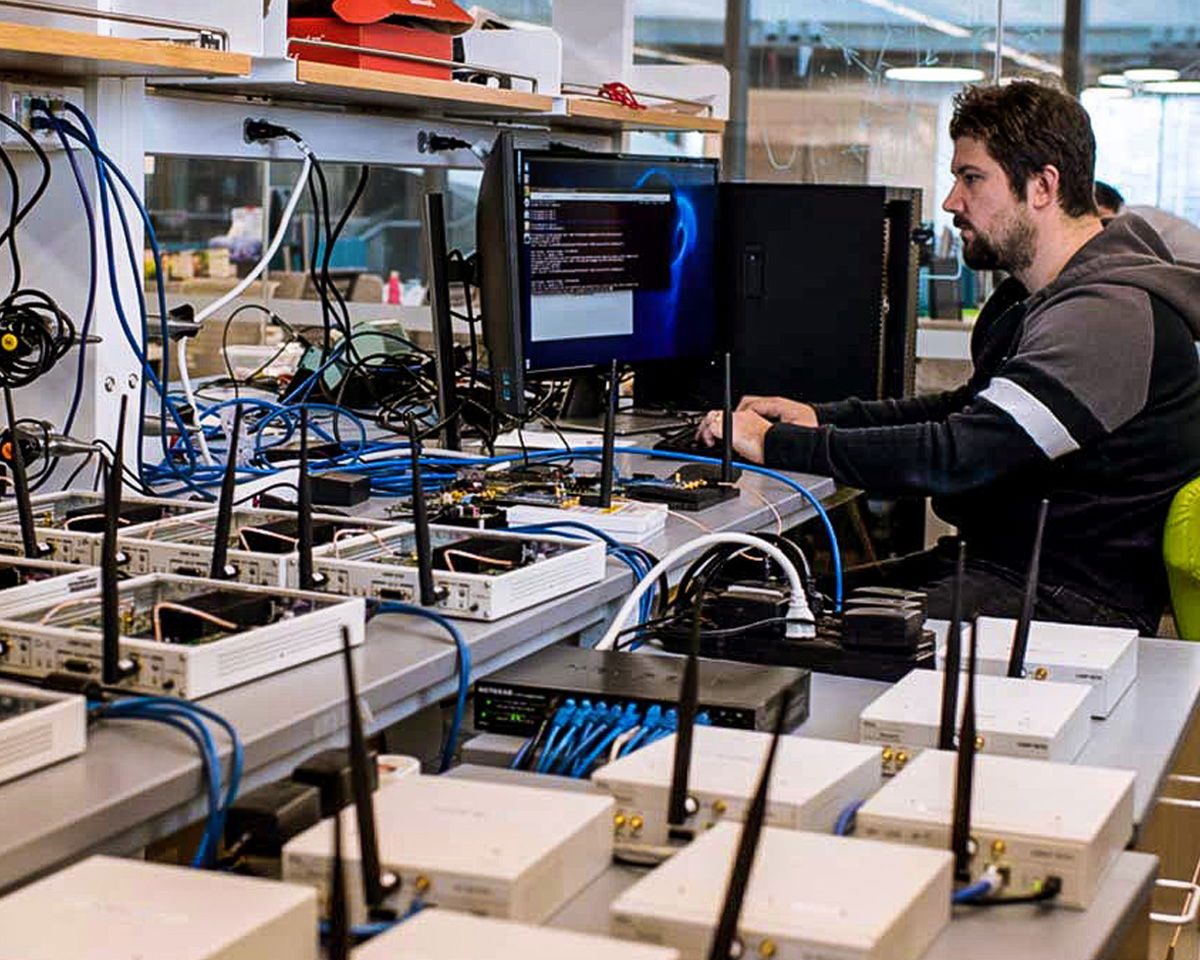
Northeastern’s Institute for the Wireless Internet of Things maintains strong relationships with leading companies in the wireless, defense, computing, and manufacturing fields that sponsor its research-creating unique co-op and research opportunities for students. Students conduct research and experiential projects at the Institute for the Wireless Internet of Things, a leading center for next-generation wireless and wired communication networks-with emphasis on 6G wireless systems, machine learning applications for network orchestration and management, and overall large-scale experimental research.
Students have the use of test beds such as Colosseum, the world’s largest wireless RF emulation platform, as well as X-Mili and TeraNova, the largest millimeter-wave and terahertz networking platforms in the nation. Students are also given exclusive access to on-campus FCC-designated Spectrum Innovation Zones-among only a few such zones in the nation. Northeastern is also one of only a handful of universities that are part of the International Telecommunication Union (ITU), the United Nations’ specialized agency for information and communication technologies.
Northeastern is an R1 research institution ranked No. 1 in internships/co-ops by U.S. News & World Report. Its research at the Institute for the Wireless Internet of Things is supported by several companies and institutions.
Advance your career with a paired degree: earn a Master of Science in Wireless and Network Engineering while completing a Graduate Certificate in Engineering Leadership through Northeastern’s Gordon Institute of Engineering Leadership. This powerful combination lets you gain deep technical expertise alongside hands-on leadership experience, including a 16-semester-hour certificate with an industry-based challenge project guided by multiple mentors. Prepare to lead and innovate in engineering organizations. To pursue this path, you must be admitted to The Gordon Institute.
Admissions
Apply to the program
A graduate degree or certificate from Northeastern can accelerate your career through rigorous academic coursework and real-world professional experience in your area of interest. Apply to take your career to the next level.
A graduate degree or certificate from Northeastern can accelerate your career through rigorous academic coursework and real-world professional experience in your area of interest. Apply to take your career to the next level.
Applications received after the stated deadline dates will be accepted and processed as quickly as possible; however it may not be possible to have a decision rendered in time for the applicant to begin taking classes for the desired term if admitted.
Applications submitted by the referenced dates will receive full consideration for the referenced term. Applications received after the referenced dates will be considered on a case-by-case basis.
*Decision notification: Applicants will be reviewed for admission on a rolling basis as they are completed.
Fall Semester Entry
| Early Action deadline: | December 1 |
| Final deadline for international applicants out-of-country: | June 15 |
| Final deadline for international applicants in-country: | July 1 |
| Final deadline for domestic applicants: | August 1 |
Spring Semester Entry
| Final deadline for international applicants out-of-country: | November 1 |
| Final deadline for international applicants in-country: | December 1 |
| Final deadline for domestic applicants: | December 1 |
Completed online application form
Two letters of recommendation
Transcripts from all institutions attended
GRE is not required for terms starting during the 2025-2026 academic years
Statement of purpose
Resumé
TOEFL, IELTS, or Duolingo for international applicants unless the waiver requirements are met
The program is suited to students with a background in electrical and/or computer engineering, computer science, or related disciplines. Strong candidates in other STEM disciplines, including both engineering and sciences (e.g., physics, math), with prior exposure to calculus, linear algebra, probability theory and programming, will also be considered.
View the Northeastern University College of Engineering admissions page for details.
Program objectives
Prepare for success
Our program aims to prepare highly qualified researchers and a specialized workforce that will lead the future of our hyperconnected society.
Join a highly qualified workforce for a career in the high-growth communication networks field with a comprehensive skill set learned through integrated computer and electrical engineering studies.
Learn to understand, design, implement, and test present and future wireless and wired communication networks through a combination of coursework, master’s thesis research, and/or industry experience.
Connect with us
Want more information?
We’re here to answer your questions about this program, the application process, and more. Complete the form below to receive additional program details and speak with a member of our enrollment team.
Occupations
Showing job titles from highest to lowest annual growth for ZIP code .
Showing job titles from highest to lowest annual growth for the postal code .
No companies available.
No skills available.
No job titles available.
Cost of attendance
Tuition and financial aid
-
$63,264Tuition in USD
Estimated Total Tuition
This is an estimate based on the tuition rates for Academic Year 2026-2027 and does not include any fees or other expenses. Some courses and labs have tuition rates that may increase or decrease total tuition. Tuition and fees are subject to revision by the president and Board of Trustees at any time. Select programs at select campuses offer additional scholarships of up to 25% off the listed price for domestic students studying on campus. For more detailed information, please visit Student Financial Services.
For students interested in pursuing financial assistance or educational loans, additional educational costs, known as Cost of Attendance (COA) components, can be included in the calculation of aid and loan eligibility. Components may include food, housing, books, course materials, supplies, equipment, transportation, personal expenses, and the cost of obtaining a first professional licensure. You can find comprehensive details on the Student Financial Services website. Please keep in mind that COA can vary significantly depending on academic program, enrollment intensity, and individual circumstances.
There are many ways to pay for your education, including scholarships, financial aid, and more. Connect with a financial counselor to learn about your options and make your dream a reality.
Visit tuition & financial aidA hub of innovation

Northeastern's first campus builds on Boston's legacy of innovation. Our 37-plus research facilities allow students and faculty to work on groundbreaking research, while our deep ties to the biotech, healthcare, education, and startup industries provide unique opportunities for learning.
#1
Best state to live in
(WalletHub, 2023)
110K+
Northeastern alumni in Greater Boston
#3
Best state for education
(U.S. News & World Report, 2024)