
Key Considerations for Choosing the Right Graduate Program
October 22, 2024
Going to graduate school is a big decision, and you want to make you choose the right program. Here are a few factors you should consider during your search.

By Kate Gibson
November 1, 2022
Applied behavior analysis (ABA) is an evidence-based approach to understanding and addressing behavior patterns that are socially significant. This dynamic field offers several career opportunities, but perhaps the most common career path is becoming a Board-Certified Behavior Analyst (BCBA).
Since the recent increase in ABA educational program offerings, which grew 113 percent in the United States from 2016–2020, there has been a noticeable spike in interest in this field. In fact, according to a government report, there’s been nearly a 250 percent growth in ABA degree completions. If you’re interested in learning more about this rewarding career, here’s an overview of the roles and responsibilities of BCBAs.
BCBAs often work directly with people from vulnerable populations that need behavioral support. Some of these groups include children with disabilities, the elderly, and even people with exceptionally dangerous jobs.
BCBAs have certification from the Behavior Analyst Certification Board. Obtaining such a credential requires a range of professional activities that hone a behavior analysts skill set. As a result of their training and experience, they often hold supervisory roles that oversee others in their field, such as Registered Behavior Technicians (RBTs) and Board-Certified Assistant Behavior Analysts (BCaBAs). BCBAs also tend to specialize in a particular facet of applied behavior analysis, such as the assessment and treatment of severe problem behavior.
If you’re interested in becoming a BCBA, here’s everything you need to know about the job responsibilities, where they work, how much they make, and how you can start a career in this exciting field.
BCBAs are healthcare professionals who study behavior patterns and create individualized plans to help clients thrive. This is accomplished through a variety of ABA strategies and tactics.
Some BCBA responsibilities include:
While these are the common job responsibilities of BCBAs, it’s important to keep in mind that they’re heavily dependent on what industry or company a BCBA works in.
Learn how an ABA degree can give you the skills you need to make a difference in the lives of others.
Due to the interdisciplinary nature of ABA, BCBAs work in various industries and sectors of business that can benefit from a better understanding of behavior and its influences. While many BCBAs work with children with developmental disabilities, such as those who identify as autistic, there are a number of businesses that are using these services in other ways.
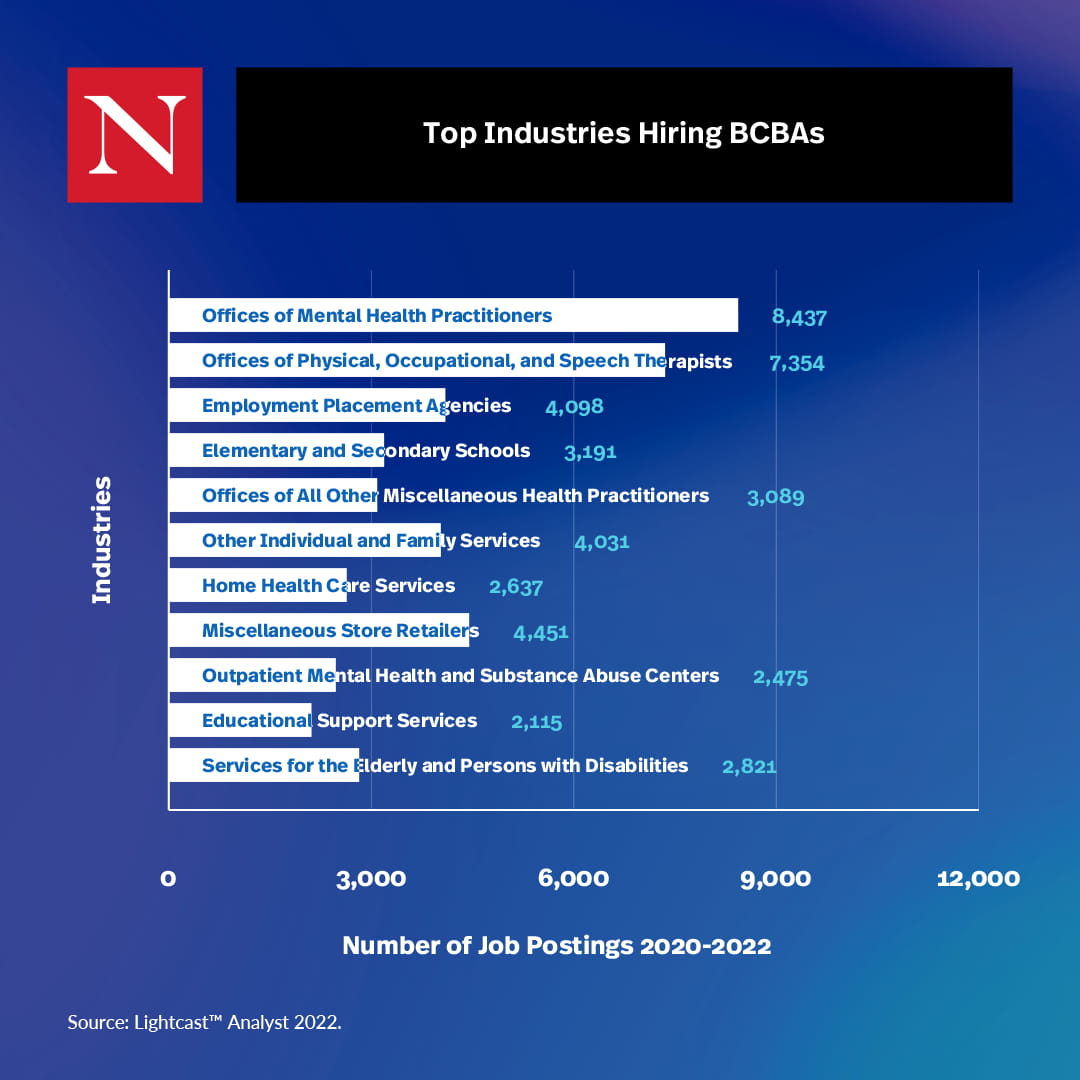
As mentioned earlier, BCBAs are prominent figures in the mental health and developmental disabilities communities. According to government data, between 2020 and 2022, the majority of BCBA job postings were found in industries such as:
This clearly aligns to BCBAs’ role in assisting individuals who are struggling with behaviors negatively impacting their quality of life.
Other businesses that have recently been hiring a large number of BCBAs operate in the education sector. Industries like elementary and secondary schools, and educational support services collectively hired over five thousand BCBAs in the last two years. This relatively high number can be partially attributed to schools’ objectives to provide more resources for students struggling with disabilities, socialization issues, or mental health challenges.
However, there are several other industries that have put a new emphasis on acquiring well-trained behavior analysts. For example, industries like employment placement agencies, retailers, and family services also hired thousands of BCBAs. While these industries might not initially seem like a perfect fit for the specialized knowledge of a behavior analyst, there are several ways it can be leveraged in these fields.
“I know a behavior analyst who works for a software company,” says Andrew Bonner, director of the Master of Science in Applied Behavior Analysis program at Northeastern University’s Charlotte campus. “They aren’t working as a behavior analyst, per se, but they’re still leveraging their experience in the field.” This is an important factor to keep in mind when considering becoming a BCBA. While the education and training is incredibly specialized, it doesn’t lead to just one industry, or even one type of company.
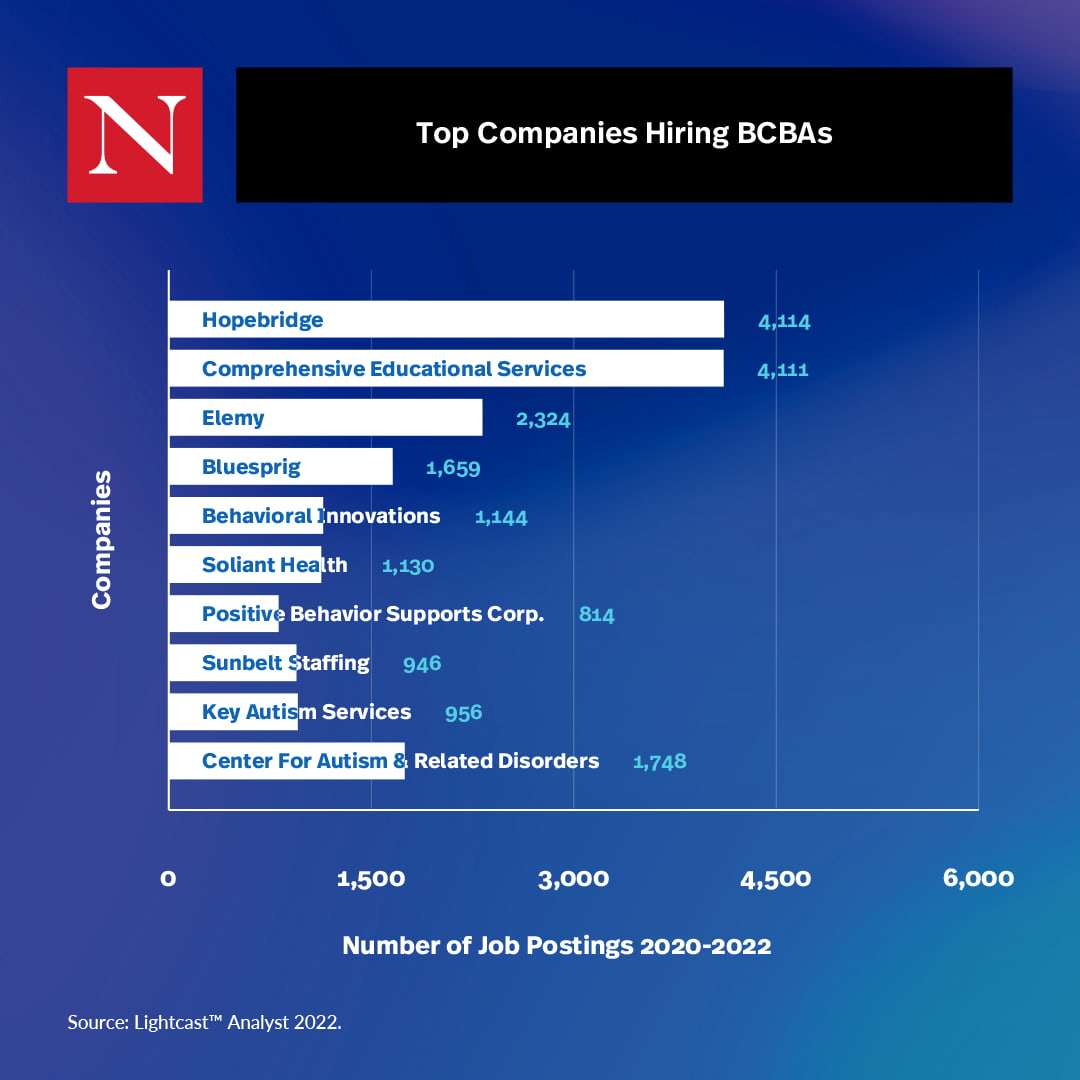
Despite the various industries that BCBAs support, the majority work with individuals with developmental disorders such as autism spectrum disorder (ASD). As a result, the top companies hiring board-certified behavior analysts largely focus on behavior analytic service provision and working with those who identify as autistic.
According to government data, the top 10 companies who hired BCBAs between 2020 and 2022 were:
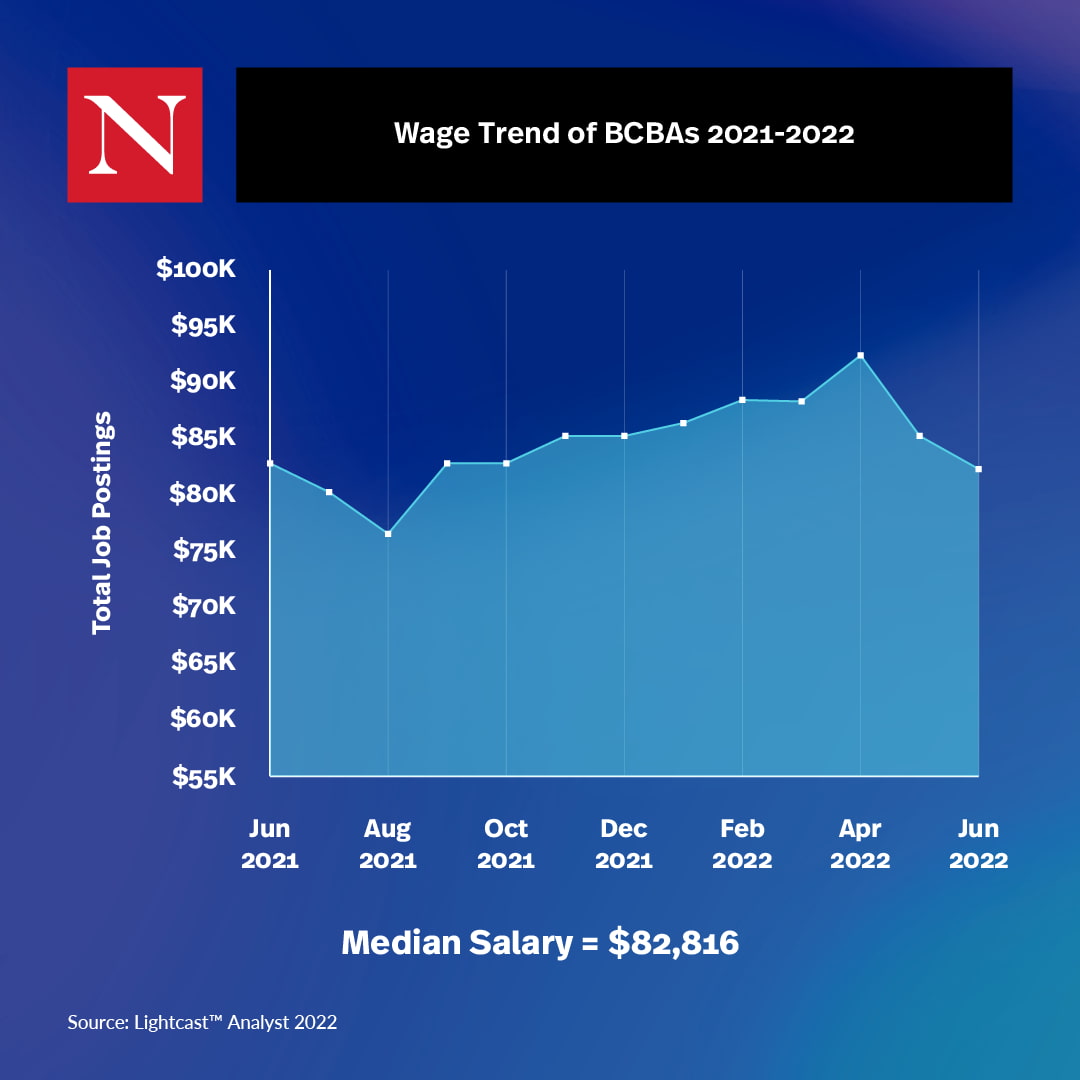
No matter what industry or company a BCBA works in, prospective behavior analysts need assurance that a career in this field promotes financial stability. According to government data, the median annual salary of a BCBA is $82,816, which is well above the national average. BCBAs are well rewarded for the time spent obtaining their advanced credentials.
With growing uncertainty around higher-earning positions retaining their pay scale, BCBAs can rest assured that their prospective salaries won’t decline. Looking closely at recent wage trends for BCBAs, there have been minimal fluctuations—constantly hovering around $82,000 per year.
Earning a degree in applied behavior analysis is the first, and most important step to becoming a BCBA. A graduate-level program, like Bouvé College of Health Sciences’s Master of Science in Applied Behavior Analysis, offers students the opportunity to learn about this exciting and dynamic field in an incredibly accessible environment.
“According to the Behavior Analyst Certification Board website, as of October 2, 2022, the number of RBT certificants this year was just over 123,000,” says Bonner. “This is because it’s pretty easy to get this credential. But BCBA certificants, which is a harder certification to obtain, was just over 58,000 this year.”
This discrepancy in RBTs to BCBAs certificants per year speaks to the rigor of activities required to obtain the BCBA credential. Graduate training programs like the one offered at Northeastern provide a road map for its students, making the process easier and more accessible.
Want to learn more about how ABA is changing the world of behavior analysis? Check out Northeastern’s Master of Science in Applied Behavior Analysis program page.

October 22, 2024
Going to graduate school is a big decision, and you want to make you choose the right program. Here are a few factors you should consider during your search.

October 11, 2022
An applied behavior analysis graduate degree prepares you for a wide range of career paths. Here's an overview of what you can do with an ABA degree.

November 17, 2022
Becoming a BCBA can be a difficult task, but understanding the requirements shouldn’t be. Here’s everything you need to know about becoming a BCBA.